What Is NAP? Why Your Business Info Must Match Everywhere
If your business name, address, or phone number changes across the web, you create a trust problem.
Sometimes that problem shows up in search visibility. Sometimes it shows up when a customer calls an old number or drives to the wrong place. Either way, the cost is real.
That is why NAP consistency still matters.
What NAP Means
NAP stands for:
- name
- address
- phone number
These are the core identity details for a local business online. They appear on your website, your Google Business Profile, maps platforms, and directory listings.
That is why NAP is not just an SEO acronym. It is the plain-language identity layer of the business online.
Why Consistency Matters
Google's local ranking model (opens in a new tab) is based on relevance, distance, and prominence. Consistent business details support prominence because they help the web presence feel coherent and trustworthy.
Google does not publish a neat percentage for NAP weighting. It does not need to. The practical issue is obvious:
- if your details match everywhere, the business looks more reliable
- if they conflict, the web presence looks less reliable
This affects both search systems and human beings.
NAP problems can quietly hurt a business even when nobody on the team is looking at rankings. They create needless uncertainty right where people expect the basics to be clear.
How NAP Problems Usually Happen
Most businesses do not create inconsistent details on purpose.
It usually happens because:
- the business moved
- the phone number changed
- an old employee made listings years ago
- directories copied bad upstream data
- the business name is written in several different ways
One bad listing is annoying. Ten bad listings start to create real friction.
What Counts as an Inconsistency
Some differences are minor. Some are not.
Examples that often matter:
- old phone number vs current phone number
- old address vs new address
- "Suite 200" on one listing and no suite on another
- legal business name in one place and branded trading name in another
The point is not perfection for every punctuation mark. The point is choosing one standard and using it consistently where customers and search systems expect core business details.
For example, "Street" versus "St." is usually less important than an old phone number, but repeated formatting drift across many listings still makes the broader profile feel less controlled than it should.
Where to Check First
Start with the places people are most likely to see:
- your website
- Google Business Profile
- Apple Maps
- Bing Places
- major local or industry directories
Then check important secondary listings.
If your business is in a regulated or directory-heavy industry, those secondary listings may matter more than you think because customers rely on them for validation.
Where NAP Needs to Match Most Closely
Not every mention of your business online carries the same weight.
The highest-priority places are the ones that directly influence customer action or local trust:
- your contact page and footer
- your Google Business Profile
- the main map platforms
- the biggest directories in your market
- any major industry listing customers actually use
This is why local citations and NAP are closely connected. A citation is usually one more place where your core business identity is being repeated. If the citation is wrong, your NAP is wrong there too.
For service businesses, the website matters even more because it often has to carry geography more clearly than the profile alone. If your service pages, city pages, and contact details do not line up, the whole local presence starts to feel less coherent.
How to Fix NAP Properly
The process is simple, even if it is tedious:
- Decide on one exact business format.
- Update your website first.
- Update Google Business Profile and major map/listing platforms.
- Fix major directories and any obvious duplicates.
- Recheck the main listings periodically.
If a data source is feeding bad information downstream, fix the source as early as possible.
How Often to Recheck It
NAP cleanup is not usually a one-time job.
It is worth rechecking when:
- the business moves
- the phone system changes
- the business name changes
- new locations are added
- a rebrand affects public-facing details
Even without those changes, a periodic review helps catch duplicate listings or stale third-party copies before they spread further.
Create a Single Source of Truth
One of the easiest ways to keep NAP clean is to decide where the official version lives internally.
That can be a shared operations document, CRM record, or internal SOP, but it should state the exact public-facing format for:
- business name
- address
- phone number
- hours where relevant
- primary website URL
That sounds small, but it reduces a surprising amount of drift. Without one source of truth, teams often invent inconsistency by accident. Marketing updates one listing. Sales uses a different phone number in an email signature. A vendor creates a profile from old onboarding notes. Six months later the business is cleaning up a problem nobody meant to create.
If the company has multiple locations, multiple phone lines, or service-area rules, document those too. Ambiguity inside the business usually becomes ambiguity outside the business.
Why NAP Problems Often Stay Hidden
One reason businesses miss NAP issues is that the damage is usually silent.
The customer who finds the wrong number does not send a helpful note. They just move on.
The person who sees conflicting address details may not complain either. They simply lose confidence or choose a competitor whose information looks more controlled.
This work is easy to undervalue. The losses are real, but they rarely announce themselves clearly.
How NAP Supports the Bigger Local SEO Picture
NAP consistency is not meant to win local SEO by itself.
It supports the broader trust layer around your profile, your citations, your service pages, and the business's general web presence. When those pieces align, the business looks more stable and more credible. When they conflict, local visibility has to work against that confusion.
That is also why NAP work should not be separated from Google Business Profile optimization or from the broader question of what local SEO actually is. If your local strategy is trying to build relevance and prominence, basic business identity hygiene is part of that job, not an optional extra.
Service-area businesses need to be especially careful here. If you hide your street address in Google because you do not serve customers there, that does not mean the rest of your public business details can get sloppy. It means your service area pages and contact information have to carry even more of the trust burden honestly.
A Practical Cleanup Workflow for Small Teams
If you want a realistic workflow instead of an open-ended cleanup project, use this order:
- Lock the official NAP format.
- Fix the website footer, contact page, and schema-bearing business details first.
- Correct Google Business Profile and major maps platforms.
- Clean up top citations and remove obvious duplicates.
- Review one layer deeper only after the main sources are accurate.
That keeps the job focused on the places that influence both customers and search systems most. It also prevents a common mistake: spending hours on low-value directories while the business website or main profile is still wrong.
It also creates a better handoff between marketing and operations. Once the official version is locked, future website edits, profile updates, and listing work become easier to review quickly instead of being reinvented every time.
The Practical Standard
The useful standard is not perfect cosmetic uniformity. It is operational clarity.
If a customer checks the main places your business appears online, they should keep finding the same answer to basic questions:
- what is this business called?
- where is it?
- how do I contact it?
If those answers keep changing depending on where they look, trust weakens fast.
Another good test is whether a new staff member or outside vendor could update your listings correctly without guessing. If the answer is no, the business probably has not defined its public identity clearly enough yet.
That operational clarity is what makes NAP maintenance sustainable. When the standard is obvious, corrections happen faster and future drift becomes easier to catch.
The Bottom Line
NAP consistency is not glamorous SEO work. It is basic trust maintenance.
When your business details match across the web:
- customers have less friction
- your listings look more reliable
- your broader local presence is easier to trust
That is why it still matters.
Need Help With Local SEO?
If you're not sure whether inconsistent business details are holding you back, we can review the major listings with you. We'll identify the obvious mismatches and explain what to fix first.
Get a free local SEO review: Contact us at [email protected]
Analysis FAQ.
What does NAP mean in local SEO?
NAP stands for name, address, and phone number. These are the core business details that appear on your website, Google Business Profile, maps, and directories.
Why does NAP consistency matter?
Consistent details make it easier for search engines and customers to trust that the business information is correct. Conflicting details create confusion and can weaken local visibility over time.
What happens if my NAP is inconsistent?
Customers may call the wrong number, visit the wrong address, or lose confidence in the business. Search engines may also have a harder time reconciling which details are correct.
Tagged with

Further Reading
Related Analysis.
What Are Local Citations? Guide for Canadian Businesses
Local citations are mentions of your business details across directories, maps, and other sites. They support local trust when the information stays accurate.
Service Area Pages: Local SEO Without a Storefront
If you serve multiple cities from one base, service area pages can help you rank beyond your main location without creating doorway pages.
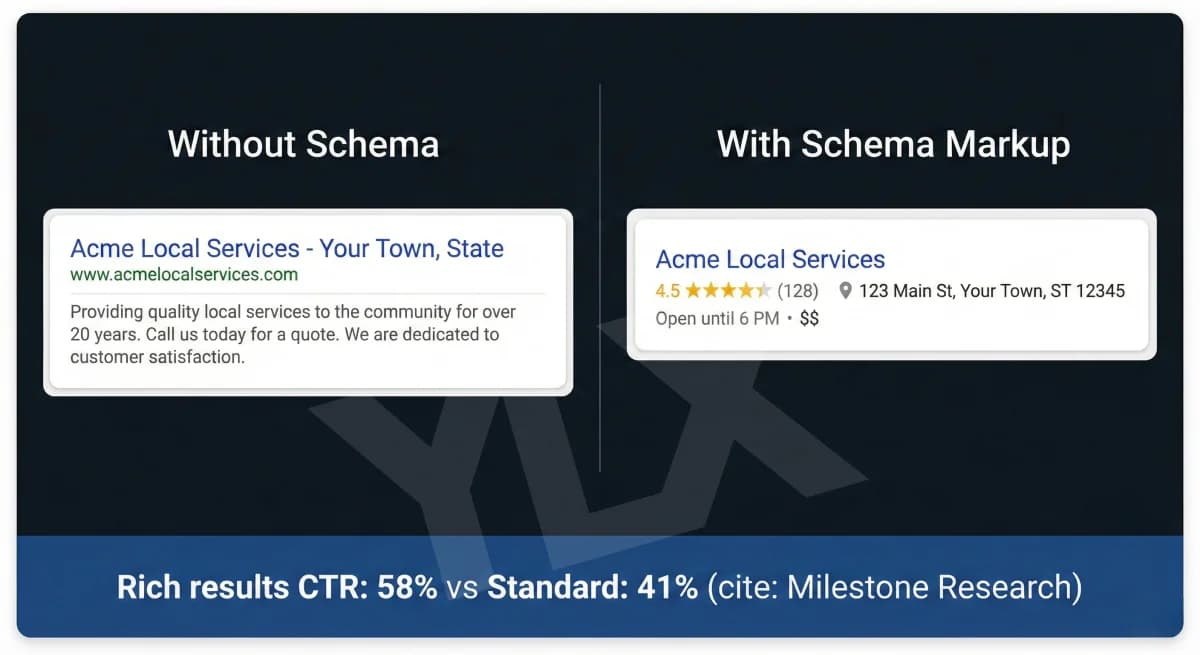
What Is Schema Markup? Structured Data for Local Business
Schema markup helps Google understand your business. Learn what it is, what properties matter, and how to add structured data to your local business website.