What Are Local Citations? Guide for Canadian Businesses
If your business exists in the real world, it will usually exist in more places online than you remember.
Maps platforms, directories, industry listings, local organizations, and review sites all create mentions of your business details. Those mentions are called local citations.
They are not the whole local SEO game, but they still matter because they help reinforce that your business is real, reachable, and described consistently across the web.
What a Citation Is
A local citation is any online mention of your business details, most often:
- name
- address
- phone number
Sometimes a citation also includes:
- website URL
- business category
- hours
- description
Some citations are structured, like a directory listing. Others are unstructured, like a local article or association page that mentions your business.
Why Citations Matter
Google's local ranking model (opens in a new tab) includes prominence, which is partly about how established and trusted the business appears online.
Citations support that picture by giving search systems multiple places to confirm your business details. They also help real people find the right phone number, address, or website.
The practical value is not "more citations no matter what." The practical value is:
- accurate details
- reputable platforms
- fewer contradictions across the web
Citation work is often more like cleanup than growth hacking. It is about reducing ambiguity.
That is also why citation work overlaps with NAP consistency. If your business name, address, or phone number is drifting across the web, citation cleanup is one of the places where that drift becomes visible fast.
Structured vs Unstructured Citations
Structured citations are formal listings on platforms such as:
- Google Business Profile
- Apple Maps
- Bing Places
- YellowPages
- industry directories
Unstructured citations are mentions inside:
- local news stories
- chamber of commerce pages
- blog posts
- community organization pages
Both can help. Structured citations are easier to maintain. Unstructured citations can add local proof and credibility. Unstructured citations are closely tied to your broader brand identity strategy - how your business earns authority, establishes trust, and presents its reputation across digital channels.
The maintenance work is different, though. Structured citations are usually something you can correct directly. Unstructured citations are more about reputation, partnerships, coverage, and earned media.
What Good Citation Work Looks Like
Good citation work is mostly maintenance, not tricks. But correcting directory profiles is only one layer of search visibility. To turn geographic presence into consistent customer leads, you need a cohesive local SEO strategy that optimizes your entire crawl footprint, entity schema, and local landing pages.
That means:
- correct business details
- consistent naming
- major platforms cleaned up first
- duplicate listings removed where possible
It also means not treating every directory on the internet like it deserves your time.
For most businesses, citation work should feel boring. If it feels clever, you are probably drifting toward low-value directories or unnecessary volume.
Where Canadian Businesses Should Focus First
For most Canadian businesses, the order is usually:
- Google Business Profile
- Apple Maps
- Bing Places
- major national or local directories
- relevant industry or association listings
The best citations are the ones customers actually use and the ones search systems are most likely to trust.
Here is a comparison of the top citation platforms available for Canadian businesses:
| Platform | Target Audience & Use Case | Validation Type | Cost | Domain Authority & Search Trust |
|---|---|---|---|---|
| Google Business Profile | Universal Local Search & Google Maps | Postcard, Video, or Email OTP | Free | Maximum (100) |
| Apple Maps (Business Connect) | iOS/macOS Users & Siri Searches | Phone SMS or Business Documents | Free | High / Direct Integration |
| Bing Places | Windows Users & Edge Search / Copilot | Phone SMS, Email, or Postcard | Free | High (95+) |
| YellowPages.ca | Legacy Canadian Directories | Phone SMS, Email, or Rep Call | Free (Paid tier available) | High Canadian Authority (88+) |
| Yelp.ca | Consumer Reviews & Local Discovery | Phone SMS or Email | Free (Aggressive ads upsell) | High Authority (90+) |
That is also why local context matters. A niche trade directory, professional association page, or local chamber listing may carry more practical value than a random national directory that nobody visits.
For most businesses, this is a better priority model than chasing volume:
- platforms customers actually check
- platforms Google is likely to understand and trust
- association or trade listings that reinforce legitimacy
- local organization mentions that support real community presence
That order keeps the work tied to visibility and trust instead of turning into directory busywork.
Common Citation Problems
Citation problems usually come from:
- outdated addresses
- old phone numbers
- duplicate listings
- inconsistent business names
- bad data copied from an upstream source
These issues often linger for years because nobody owns them internally.
The most expensive citation problems are usually not SEO-only problems. They are operational problems too. An old number, old address, or duplicated listing creates customer friction long before anyone notices a ranking issue.
How to Approach Citation Cleanup
A sensible cleanup process usually looks like this:
- lock the correct business format first
- fix the website and primary listings
- remove obvious duplicates
- work through the most visible secondary sources
- review again after changes propagate
This is slower than one-click local SEO promises, but it is much more reliable.
It also helps to separate four different jobs that businesses often mix together:
- correcting wrong information
- removing duplicates
- claiming unmanaged profiles
- deciding which low-value listings to ignore
Those are not the same task. Some listings deserve cleanup because they are visible and wrong. Some deserve no time at all because nobody uses them and they do not materially support trust.
Structured Accuracy Beats Citation Volume
One of the easiest traps in local SEO is assuming that more listings automatically means better visibility.
That often leads to:
- low-quality directory submissions
- duplicate records
- inconsistent naming
- more cleanup later
A smaller set of strong, accurate citations is usually more valuable than a large messy footprint.
That point matters even more in Canadian local SEO because many businesses operate across provincial, regional, and niche industry contexts at the same time. A clean footprint on the listings that matter in your actual market is usually stronger than a bloated footprint spread across generic directories with no real customer use.
How Citations Support the Broader Trust Layer
Citations are strongest when they support the same reality shown by your website, your Google Business Profile, and your other core business details.
When all of those align, the local presence feels more coherent. When they do not, citations become one more place where the business looks uncertain.
That is why citation work should usually be paired with:
- Google Business Profile cleanup
- NAP standardization
- better local SEO fundamentals
- a comprehensive local SEO strategy that coordinates profiles and on-page signals
If those pieces disagree with each other, citations stop reinforcing the business and start fragmenting it.
When Citation Work Matters Most
Citation work tends to matter most when the business has changed materially or when local visibility is weaker than it should be for reasons that basic profile work alone does not explain.
Typical triggers include:
- a recent move
- a changed phone number
- duplicate listings
- lingering old brand details
- customer confusion about contact information
In those situations, citation cleanup is often one of the fastest trust repairs available.
It also matters when the business is trying to grow into new service areas. If you want stronger organic visibility outside your immediate city, your public business details need to look stable while your service area pages explain where and how you actually work.
What Citations Cannot Fix by Themselves
Citations help support local trust, but they do not replace the rest of the local SEO system.
They will not compensate for:
- a weak website
- confusing service pages
- poor reviews
- a badly maintained Google Business Profile
Citation work should be treated as foundational maintenance rather than a standalone shortcut.
They also cannot fix weak differentiation. If every city page says the same thing and every profile looks half-maintained, adding more directory mentions will not create trust on its own. Citation work is strongest when the business already has a clear service story and is using citations to support it.
A Realistic Citation Standard for Small Businesses
Most small businesses do not need an aggressive citation campaign.
They need a citation standard:
- core listings claimed
- business details consistent
- duplicates reduced
- major errors corrected quickly
- new changes reflected across the important sources
That standard is maintainable. It can survive a move, a rebrand, or a phone-number change because there is a clear process behind it.
How to Decide Which Citations Deserve Attention
If you are unsure whether a listing matters, ask:
- Would a real customer use this source?
- Could Google reasonably treat it as a trust or entity-confirmation source?
- Is the information there wrong, incomplete, or duplicated?
- Does it reinforce the markets and services we actually want?
If the answer is no across the board, the listing probably does not deserve much of your time.
That kind of filtering is what keeps citation work strategic. The goal is not to make the business appear everywhere. The goal is to make it appear accurately and credibly in the places that support discovery and trust.
The Bottom Line
Local citations are not a magic ranking lever. They are part of the trust layer around a local business.
If your business details are accurate and consistent across the important platforms, that supports stronger local visibility and fewer customer mistakes. If the details are messy, citations become a drag instead.
That is why citation work still matters.
For most businesses, the right goal is not maximum directory presence. It is a controlled, believable footprint that supports how the business actually operates and how customers really search.
Local Citation Strategy FAQ
Here are answers to key questions about managing your Canadian local citation footprint:
What is NAP standardization and why does it matter?
NAP stands for Name, Address, and Phone Number. Standardization is the practice of keeping these three data points identical across all directories. For example, writing "Suite 100" on one platform and "#100" or "Ste 100" on another can confuse search engine crawlers and degrade your local search authority. While modern engines are better at parsing variations, strict consistency eliminates matching ambiguity.
What is the difference between implied and express geographic consistency?
Express geographic consistency refers to explicit address matches across structured directories (such as standard NAP listings). Implied geographic consistency relies on unstructured context, such as mentions of regional landmarks, transit routes, or neighborhood names in your website content or local press, providing complementary local validation.
How often should a business perform a citation directory audit?
An annual citation audit is sufficient for most stable businesses. You should also run an audit immediately after operational triggers like moving to a new address, shifting phone numbers, or undergoing a business rebrand.
Need Help With Local SEO?
If you're not sure which listings matter or where your business details are inconsistent, we can review the main citation sources with you and explain what to clean up first.
Get a free local SEO review: Contact us at [email protected]
Analysis FAQ.
What is a local citation?
A local citation is an online mention of your business details, usually your name, address, and phone number. Citations appear on maps, directories, review sites, and sometimes news or local organization pages.
How many citations does a business need?
There is no universal target number. The priority is accuracy on the listings that matter most to your customers and market, not chasing a raw count.
Do citations still matter for local SEO?
Yes. Consistent business details across reputable sources still support trust and local prominence, even though citations are only one part of local SEO.
What is NAP standardization?
NAP standardization is the practice of keeping your business Name, Address, and Phone number exactly identical across all web directories. While search engines can parse variations like 'Ste' and 'Suite', strict standardization eliminates any matching ambiguity and reinforces trust.
Tagged with

Further Reading
Related Analysis.
What Is NAP? Why Your Business Info Must Match Everywhere
NAP means name, address, and phone number. When those details conflict online, customers get confused and local-search trust gets weaker.
Service Area Pages: Local SEO Without a Storefront
If you serve multiple cities from one base, service area pages can help you rank beyond your main location without creating doorway pages.
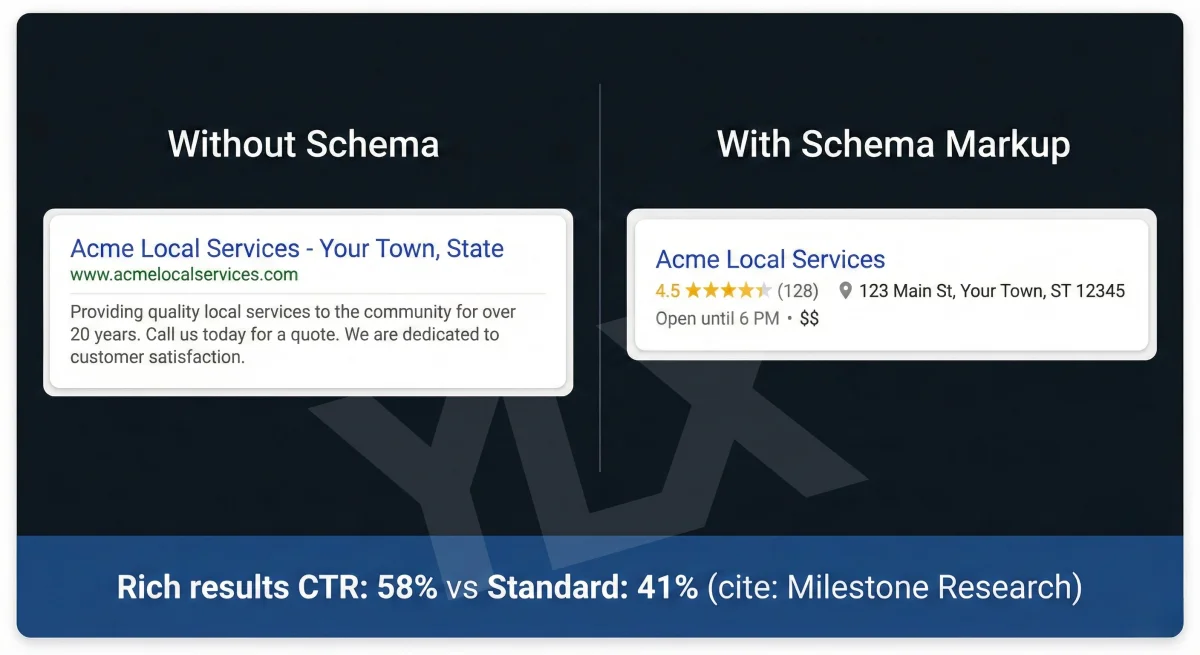
What Is Schema Markup? Structured Data for Local Business
Schema markup helps Google understand your business. Learn what it is, what properties matter, and how to add structured data to your local business website.