Custom vs Template Websites: What Fits Your Business?
You need a website. You've seen ads for Wix and Squarespace promising you can build one in an afternoon. You've also gotten custom website quotes from web developers that made you wince.
So which route makes sense? The honest answer: it depends on what your website needs to do for your business. Let me walk you through the real differences, with actual data, so you can make an informed decision.
The Current Landscape
About 60% of websites (opens in a new tab) are now built using templates or website builders. That number keeps climbing because these platforms have gotten genuinely better.
Here's the market breakdown:
- Wix holds 45% of the website builder market (opens in a new tab) with about 8 million live sites
- Squarespace powers roughly 3 million websites (opens in a new tab)
- WordPress (with themes) runs on 43% of the web (opens in a new tab), though many of those sites are inactive
There's also a new player: AI website builders. According to recent surveys, 50% of small businesses in the US (opens in a new tab) now use AI-powered tools to build or manage their websites. That number is projected to hit 98% by 2026.
What this means for you: You have more options than ever. But more options doesn't mean the choice is easier.
What You're Actually Choosing Between
Template Websites
Template websites use pre-built designs you customize with your content. Platforms like Wix, Squarespace, and WordPress themes fall into this category.
What you get:
- Pre-designed layouts you can modify
- Drag-and-drop editing
- Built-in hosting and security (on platforms like Wix/Squarespace)
- Lower upfront cost
What you give up:
- Design uniqueness (thousands of sites use the same templates)
- Full control over performance and code
- Easy migration if you want to leave the platform
Custom Websites
Custom websites are designed and built specifically for your business, usually by a developer or agency.
What you get:
- A design that's yours alone
- Code optimized for your specific needs
- Full ownership and control
- Better long-term flexibility
What you give up:
- Lower upfront cost
- Speed to launch
- The ability to make changes yourself without technical knowledge
AI-Built Websites
This is the newest category. Tools like Wix ADI, Hostinger AI Builder, and standalone AI platforms can generate a website from a few prompts.
What you get:
- A functional site in hours, sometimes minutes
- Very low cost (often free to start)
- No design or technical skills needed
What you give up:
- Quality. AI-built websites often miss basic local SEO implementation details
- Uniqueness (AI tools produce similar-looking results)
- The ability to stand out from competitors using the same tools
The Real Cost Comparison
Let me give you actual numbers, not ranges designed to make everything sound affordable.
Upfront Costs
| Option | Typical Cost |
|---|---|
| DIY (Wix, Squarespace) | $17-$36/month |
| WordPress with developer setup | $2,000-$4,000 upfront |
| Shopify (e-commerce) | $29-$79/month + apps |
| Custom development | $5,000-$20,000+ |
The Hidden Math: Total Cost of Ownership
Upfront cost is only part of the picture. Let's do the math over five years:
Wix or Squarespace (DIY):
- Platform subscription: ~$29/month × 60 = $1,740
- Apps and add-ons (scheduling, forms, email marketing, SEO tools): ~$30/month × 60 = $1,800
- Your time building and maintaining: [not counted]
- 5-year total: ~$3,540 (plus your time)
WordPress (with developer setup):
- Initial site build: $2,000
- Hosting: $25/month × 60 = $1,500
- Premium plugins (SEO, security, forms, backups): $350/year × 5 = $1,750
- 5-year total: ~$5,250
Shopify (e-commerce):
- Platform: $29/month × 60 = $1,740
- Transaction fees (2.9% + $0.30 per sale): varies with sales volume
- Apps (reviews, email, upsells): ~$100/month × 60 = $6,000
- Premium theme: $180-350 one-time
- 5-year total: ~$8,000-10,000+ depending on sales and apps
Custom Route:
- Initial site: $6,000
- Hosting, maintenance, and content updates: $100/month × 60 = $6,000
- 5-year total: ~$12,000
The DIY route looks cheapest on paper, but doesn't account for your time or the fact that your site looks like thousands of others using the same templates. WordPress gives you more flexibility but requires ongoing plugin management and security updates. Shopify makes sense for e-commerce but costs add up quickly with apps and transaction fees.
The custom route costs more. What you're paying for: a design that's yours alone, a site that actually performs well (100% Core Web Vitals scores), ongoing support and content updates handled for you, and zero time spent managing plugins or platform updates. Whether that's worth it depends on how much your time is worth, how much standing out matters in your market, and how important your website is to generating business.
5-year total cost comparison of website options: Wix/Squarespace $3,540, WordPress $5,250, Shopify $8,000-10,000+, Custom $12,000
Performance: The Numbers Don't Lie
Google measures website performance through Core Web Vitals. These metrics affect both your search rankings and whether visitors stick around or leave.
Here's how different platforms perform, based on June 2025 data (opens in a new tab):
| Platform | Sites Passing Core Web Vitals |
|---|---|
| Shopify | 75.2% |
| Wix | 70.8% |
| Squarespace | 67.7% |
| WordPress | 46% (mobile) |
| YLX custom builds | 100% |
A few things stand out here:
Wix and Squarespace have improved significantly. If you'd asked me a few years ago, I would have said templates are always slower. That's no longer true across the board. These platforms have invested heavily in performance.
WordPress still struggles. Nearly half of WordPress sites fail Google's mobile performance standards. This is usually due to theme bloat and plugin conflicts, not WordPress itself.
What this means for you: Ask for actual performance data from whoever builds your site. If they can't show you Core Web Vitals scores for sites they've built, that tells you something.
The DIY Reality Check
Website builders promise you can build a professional site yourself. Here's what actually happens.
DIY platforms are faster to start, but many owners still hit the same bottlenecks:
- Design and layout decisions take longer than expected
- Security and maintenance still require attention
- Custom features often need paid apps or technical help
- Publishing fast is easy, but building a high-performing lead engine takes work
The "build it in an afternoon" promise rarely matches reality. You might get something live quickly, but getting it to actually work well for your business takes longer than the marketing suggests.
The DIY promise vs reality: 91% found it challenging, 37% struggled with design, 31% with security, 27% with custom features
I'm not saying DIY is wrong. I'm saying budget your time realistically.
When Templates Make Sense
Templates aren't always the wrong choice. Here's when they work:
You're Testing a Business Idea
If you're not sure your business will work, spending $5,000+ on a website doesn't make sense. Get something functional, validate the concept, then invest in something better.
Your Website Is a Digital Business Card
If customers find you through referrals, not search, and your website just needs to confirm you exist and show how to contact you, a simple template handles that fine.
You Have Strong Design Skills
If you genuinely understand design principles and can make a template look professional, the platforms give you enough flexibility to create something decent.
Your Budget Is Under $2,000
If $2,000 is your absolute ceiling, a template is better than no website. Just understand the limitations you're accepting.
When Custom Makes Sense
Your Website Drives Business
If customers find you online, research you online, and decide to contact you based on your website, that site is a revenue-generating asset. It deserves real investment.
Research shows (opens in a new tab) that web design influences 94% of first impressions. A well-designed interface can deliver up to 200% improvement in conversion rates. For businesses where the website is the primary sales tool, custom design pays for itself.
You're in a Competitive Market
If your competitors have professional, fast, distinctive websites and you show up with something that looks like everyone else's template, you're starting at a disadvantage.
You Need Specific Functionality
Booking systems, custom calculators, member portals, integrations with your other business tools. If your business needs features that templates don't offer out of the box, you'll spend more trying to force a template to do something it wasn't designed for.
You Want to Own Your Platform
With most website builders, you don't fully own your site. If Wix or Squarespace changes their pricing, limits features, or shuts down, you're stuck. Exporting your site is often difficult or impossible.
Custom sites built on open frameworks belong to you. You can host them anywhere, modify them however you want, and you're never locked into a single vendor.
You're Building for the Long Term
If you're planning to run this business for years, a custom site built on modern architecture will age better. You won't hit platform limitations as your business grows, and you won't be forced into changes when the platform decides to update its pricing or features.
Questions to Ask Before Deciding
About your business:
- How do customers find you? (Referrals vs. search vs. advertising)
- What do you need visitors to do on your site? (Call you? Book appointments? Buy products?)
- How competitive is your industry online?
- What's your realistic budget, including ongoing costs?
- How long do you expect to use this website?
If you're considering DIY:
- How much is your time worth? (Hours spent wrestling with a builder have a cost)
- Do you have design skills, or will your site look like you built it yourself?
- Can you handle the technical aspects of security, backups, and updates?
If you're hiring someone:
- Can they show you Core Web Vitals scores for sites they've built?
- What happens if you want to leave their platform or service?
- What's included in ongoing maintenance, and what costs extra?
- Will you own the code and design, or are you licensing it?
What We Build
We build custom websites on modern frameworks (Next.js), optimized for performance from day one.
Here's what that means in practice:
Custom design: Your site doesn't look like anyone else's. We design for your brand, your customers, and your business goals.
Modern architecture: Static site generation means your site loads fast and has fewer security vulnerabilities than traditional platforms. No database to hack, no plugins to update.
Performance built in: Our sites score 90+ on Google PageSpeed and pass 100% of Core Web Vitals. That's not something we optimize for after the fact. It's how we build from the start.
You own it: No proprietary platform lock-in. If you want to take your site somewhere else, you can.
Ongoing support included: Our monthly plan covers hosting, maintenance, security, and content updates when you need them. You're not left figuring things out on your own.
The Bottom Line
Choose templates if:
- You're testing a business idea
- Your website is just a basic online presence
- Budget is your primary constraint
- You have time to learn the platform
Choose custom if:
- Your website directly generates revenue or leads
- You're in a competitive market
- You need specific functionality
- You want to own your platform long-term
Be cautious of AI builders if:
- Local SEO matters to your business
- You want to stand out from competitors
- You need anything beyond basic functionality
The right choice depends on what your website needs to do for your business, not on what's cheapest upfront. If you already have a site and you're trying to decide whether it needs a tweak or a total overhaul, our website redesign checklist walks through the decision step by step.
Not Sure Which Route Makes Sense?
If you're trying to figure out what approach fits your situation, we're happy to talk it through. We'll ask about your business, your goals, and your budget, then give you an honest recommendation, even if that recommendation is "a template would work fine for what you need."
Get a free consultation: Contact us at info@ylx.ca
Analysis FAQ.
How much does a custom website cost vs a template?
Template websites (Wix/Squarespace) cost $17-36/month, while custom development typically costs $5,000-$20,000+ upfront. Over 5 years, total cost is roughly $3,540 for DIY templates, $5,250 for WordPress, and $12,000 for custom - but custom includes ongoing support and superior performance.
Are template websites good for SEO?
Template websites have improved significantly. Current data shows Shopify sites pass Core Web Vitals 75.2% of the time, Wix 70.8%, and Squarespace 67.7%. However, WordPress only passes 46% on mobile, and 62% of AI-built websites fail basic local SEO requirements.
When should I choose a template website?
Templates make sense when you're testing a business idea, your website is just a digital business card, you have strong design skills, or your budget is under $2,000. They're best for situations where the website isn't your primary source of leads or revenue.
When should I invest in a custom website?
Custom websites make sense when your website drives business, you're in a competitive market, you need specific functionality, you want to own your platform without vendor lock-in, or you're building for the long term. Strong design and performance usually matter more as competition increases.
Tagged with

Further Reading
Related Analysis.
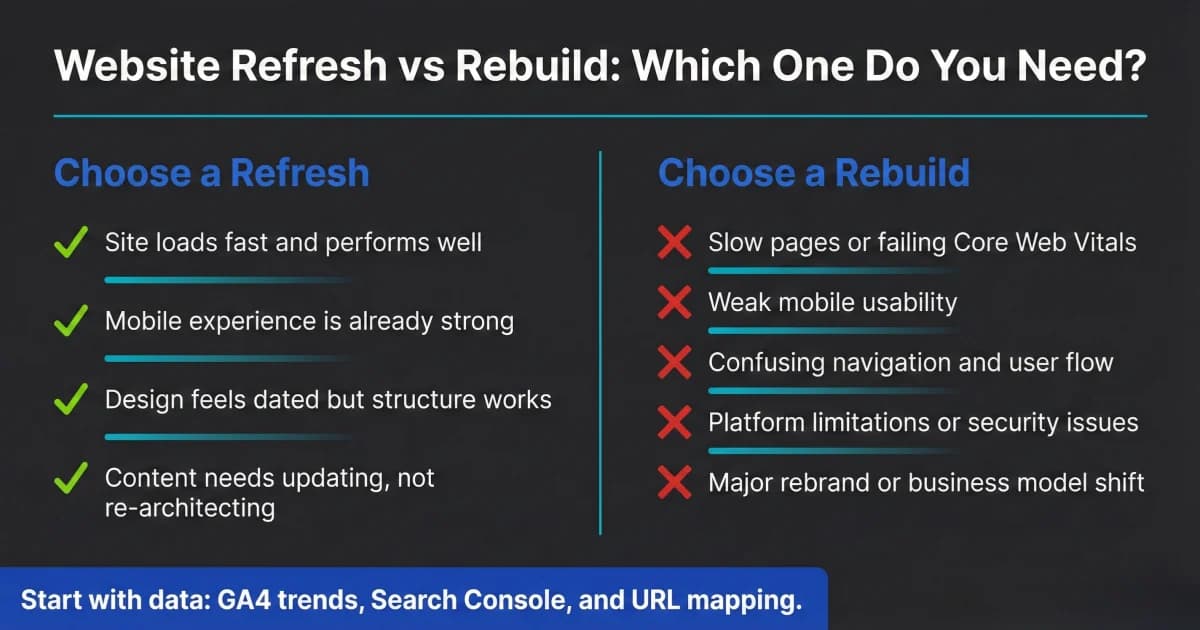
Website Redesign Checklist: Refresh or Rebuild in 2026
Not every website needs a full rebuild. Use this website redesign checklist to decide refresh vs. rebuild, what to prioritize, and how to protect SEO safely.
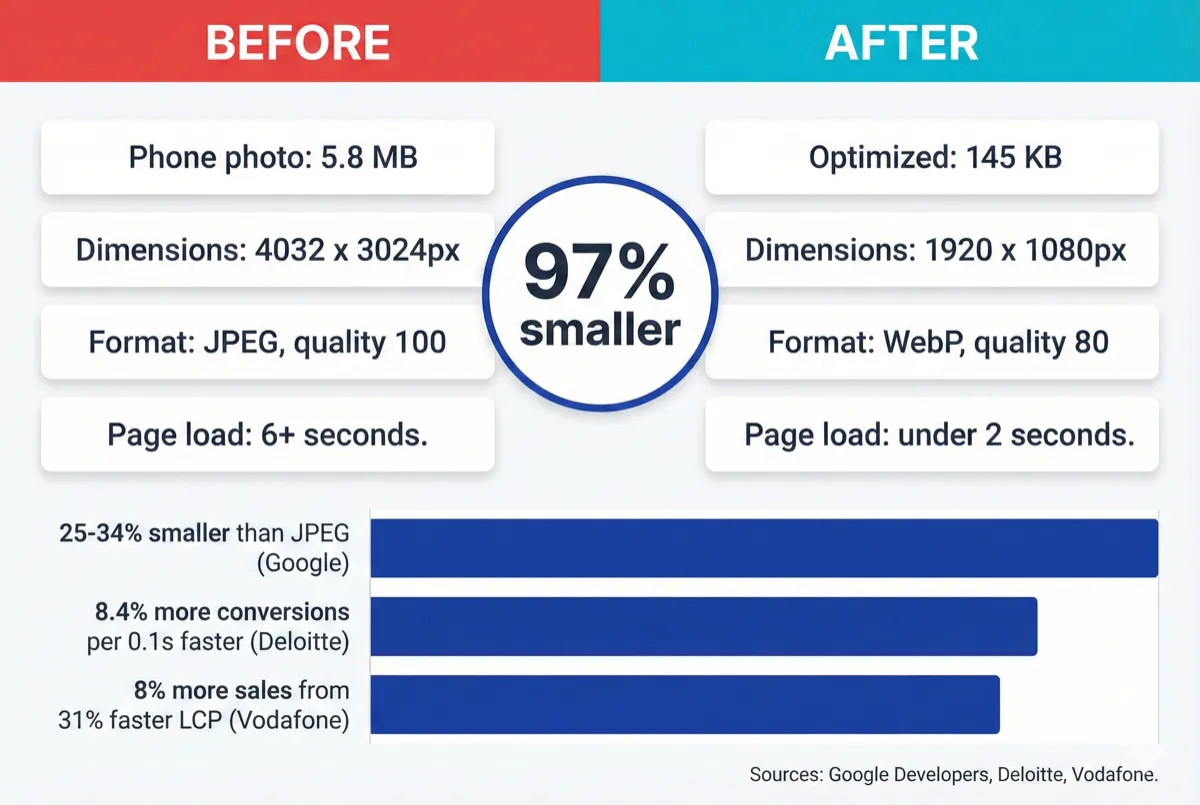
How to Optimize Your Website Images With WebP (2026)
Your website images are probably too large. Learn how to convert to WebP, resize for the web, and serve fast-loading images without visible quality loss.
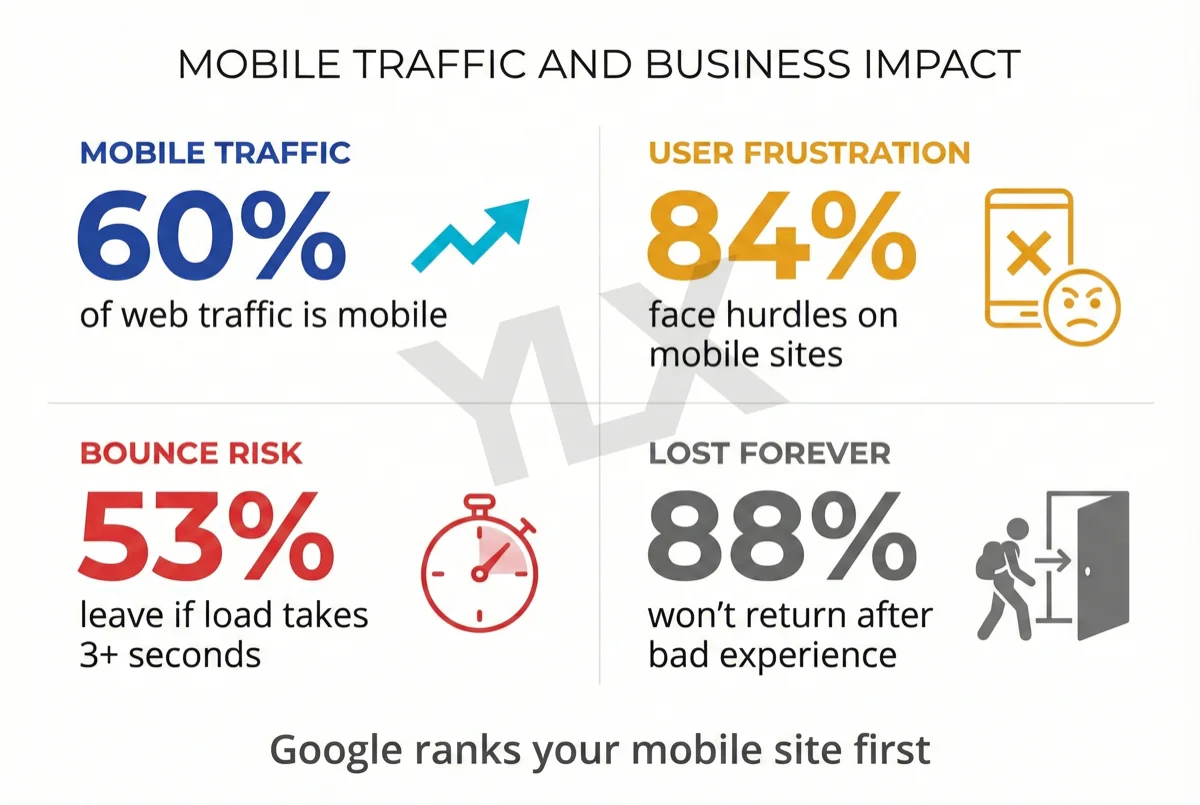
What Is Responsive Design? Why Your Site Must Adapt
Responsive design makes your website work on any screen. With mobile and desktop traffic now close to parity and Google indexing mobile-first, it is a core business requirement.