Bill C-27 Failed: What Canadian Businesses Do Next
If you searched "Bill C-27 Canada privacy" because you thought a new federal private-sector privacy law was already in force, stop there. It is not.
As of April 16, 2026, Bill C-27 did not become law and no replacement federal private-sector privacy bill is in force. The practical job for businesses is still to comply with the rules that already apply today.
What Actually Happened to Bill C-27
Bill C-27 was the Digital Charter Implementation Act, 2022. It proposed the Consumer Privacy Protection Act, the Personal Information and Data Protection Tribunal Act, and the Artificial Intelligence and Data Act.
Parliament's own LEGISinfo record (opens in a new tab) shows:
- it was introduced in June 2022
- it completed second reading
- it reached committee study
- it never reached report stage, third reading, or Royal Assent
That same record is marked as part of the prior session that ran until January 6, 2025. In practical terms, that means Bill C-27 is not active law.
What Law Still Applies
For most private-sector businesses in Ontario, the current federal baseline is still PIPEDA.
The active statute is the Personal Information Protection and Electronic Documents Act (opens in a new tab). If your website collects personal information through forms, analytics, newsletter signups, or customer systems tied to commercial activity, you are already operating inside that framework.
The key point is simple: your business does not get to wait for future reform before taking privacy seriously.
For website owners, that usually means the current risk is not legislative confusion in the abstract. It is the everyday mismatch between what the site collects, what the team thinks it collects, and what the policy says it collects.
Why Quebec Law 25 Changes the Practical Standard
Quebec's private-sector privacy regime, often referred to as Law 25, adds obligations that many businesses now treat as the higher standard to design around.
The governing statute is Quebec's Act respecting the protection of personal information in the private sector (opens in a new tab).
Depending on your activities, that can mean stronger expectations around:
- accountability
- governance policies
- privacy impact assessments
- incident tracking
- disclosure and consent handling
If your business serves Quebec customers, even from Ontario, this should affect how you think about your website, your data flows, and your policy language.
That does not mean every Ontario business suddenly needs a Quebec-specific legal rewrite for every page. It does mean many teams are safer building to the higher practical standard where possible instead of maintaining two weaker standards badly.
What Business Owners Should Fix Now
The biggest real-world problem is usually not "missing a future law."
It is that the website, the scripts, and the policy no longer match each other.
That mismatch creates risk quickly:
- the privacy policy says one thing
- the site does another
- old scripts still fire
- forms collect fields nobody can justify
- data moves to vendors the team barely remembers adding
That is where most cleanup work should begin.
A Useful Way to Think About Website Privacy
Most business websites are not giant data systems. But they are still operating small privacy systems every day.
If the site has:
- a contact form
- analytics
- an email signup
- a booking tool
- advertising tags
then it is already collecting, transmitting, or storing personal information in ways that need to be understood and managed.
That is why privacy work on websites is rarely about one document. It is about the relationship between the content, the technical implementation, and the internal process.
Step 1: Map Your Real Data Flow
Create a current inventory of every place the website touches personal information.
That includes:
- forms
- analytics tools
- advertising pixels
- booking tools
- chat systems
- email workflows
- CRM connections
For each one, record:
- what it collects
- why it exists
- where the data goes
- who owns it internally
If nobody can explain those four points clearly, the business is carrying unnecessary risk.
Step 2: Align the Policy With Reality
Many privacy policies are not exactly false. They are just too vague to be trustworthy and too stale to be reliable.
Rewrite the policy around what the site actually does today. Then update it whenever the stack changes.
If your forms, scripts, or vendors change but the policy does not, the written disclosure starts to drift away from reality. That is a problem regardless of whether Bill C-27 ever returns in a new form.
In practice, a good privacy policy review should answer concrete questions:
- what data is collected on each form?
- what third parties receive that data?
- is any cross-border processing involved?
- how long is the data kept?
- what rights or contact paths are disclosed?
If the policy cannot answer those questions clearly, it is probably too generic.
That is exactly why a generic document pulled from a template generator is rarely enough. A policy should match what the site actually does. Our guide on how to write a privacy policy for your website breaks that down in more operational detail.
Step 3: Fix Consent at the Script Level
A banner is not a privacy program.
If non-essential tracking scripts fire before the user makes a real choice, the presence of the banner does not solve much.
This is especially important if you serve Quebec users or use tools that depend on meaningful consent being handled properly.
Cookie and tracking behavior also need to match what the site tells people. If the disclosure says one thing and the scripts do another, you have a trust and compliance problem at the same time. Our article on cookie consent for Canadian websites covers that part more directly.
Step 4: Treat Marketing Systems as Privacy Systems
Businesses often separate "marketing" from "privacy." On the website, that separation is usually artificial.
If you use:
- analytics
- remarketing pixels
- newsletter forms
- lead capture tools
those are privacy systems too.
That means the consent flow, the privacy policy, and the actual tool behaviour need to agree.
This is where businesses often get surprised. A marketing pixel added for campaign tracking can create a privacy issue faster than a visibly sensitive form field, because the tracking becomes easy to forget while the data still moves.
That is why stack audits matter.
A Practical Operating Standard for 2026
If you want a simple working standard while federal reform stays unsettled, use this:
- know what the site collects
- know where it goes
- disclose it clearly
- gate non-essential tracking properly
- assign responsibility internally
That approach is durable whether a future federal bill resembles C-27 or not.
Step 5: Assign Ownership for Incidents and Updates
Privacy risk gets worse when nobody owns the process.
Assign responsibility for:
- vendor and script reviews
- policy updates
- breach triage
- access requests
- internal signoff when the stack changes
That is much more useful than waiting for a future bill to tell you to become organized.
Why This Still Matters Even Without New Federal Reform
It is easy to think "Bill C-27 failed, so maybe the pressure is off."
That is the wrong conclusion.
The pressure on websites still comes from current law, regulator expectations, customer trust, and the basic reality that digital systems drift when nobody maintains them carefully.
The absence of a new federal bill does not remove those risks. It only means businesses need to focus on the rules that already apply instead of waiting for future reform to force the issue.
What a Reasonable Quarterly Privacy Review Looks Like
Most business websites do not need a giant formal privacy program to improve. A disciplined quarterly review is often enough to catch the main problems.
That review should confirm:
- which tools still touch personal information
- whether each tool is still necessary
- where data goes after collection
- whether consent handling still matches reality
- whether the written disclosures are still accurate
That is usually far more valuable than letting the website sit untouched until the next legal headline creates panic.
For many businesses, this review also exposes tools that no longer deserve to be on the site at all. Old pixels, abandoned forms, and forgotten integrations create privacy debt and technical debt together.
The Bottom Line
Bill C-27 did not become law.
That does not reduce the need for privacy work. It changes the focus.
The focus right now should be:
- current compliance under PIPEDA
- practical alignment with stronger provincial expectations where relevant
- real consistency between the site, the scripts, and the written disclosures
That is the work that matters today.
For owners, that is the practical takeaway that matters most. The useful question is not what Bill C-27 might have required in theory. It is whether your current website behaviour already matches the obligations and disclosures you rely on right now.
This article is educational information, not legal advice. Your exact obligations depend on your business, the data you collect, and the jurisdictions you serve. For legal interpretation, speak with a qualified privacy lawyer.
Need Help With Privacy Compliance?
If you're not sure whether your website privacy setup reflects current Canadian rules, we can review the forms, scripts, and policy alignment with you and explain what to fix first in plain terms.
Get a free privacy compliance review: Contact us at [email protected]
Analysis FAQ.
Did Bill C-27 become law in Canada?
No. Parliament's LEGISinfo record shows Bill C-27 never reached report stage, third reading, or Royal Assent, and it belongs to the prior session that ended on January 6, 2025. It is not in force.
What privacy law applies to most Ontario business websites right now?
For most private-sector businesses in Ontario, PIPEDA remains the federal baseline for commercial activity. Provincial requirements can add more obligations depending on where and how you operate.
Does Quebec Law 25 matter if my business is based in Ontario?
It can. If your business serves Quebec customers or handles their personal information, Law 25 can raise the practical standard you should build toward.
What should I fix first on my website?
Start with a data inventory. List every form, tracking script, email workflow, and third-party tool, then make sure your policy, consent flow, and real data behaviour match.
Tagged with

Further Reading
Related Analysis.
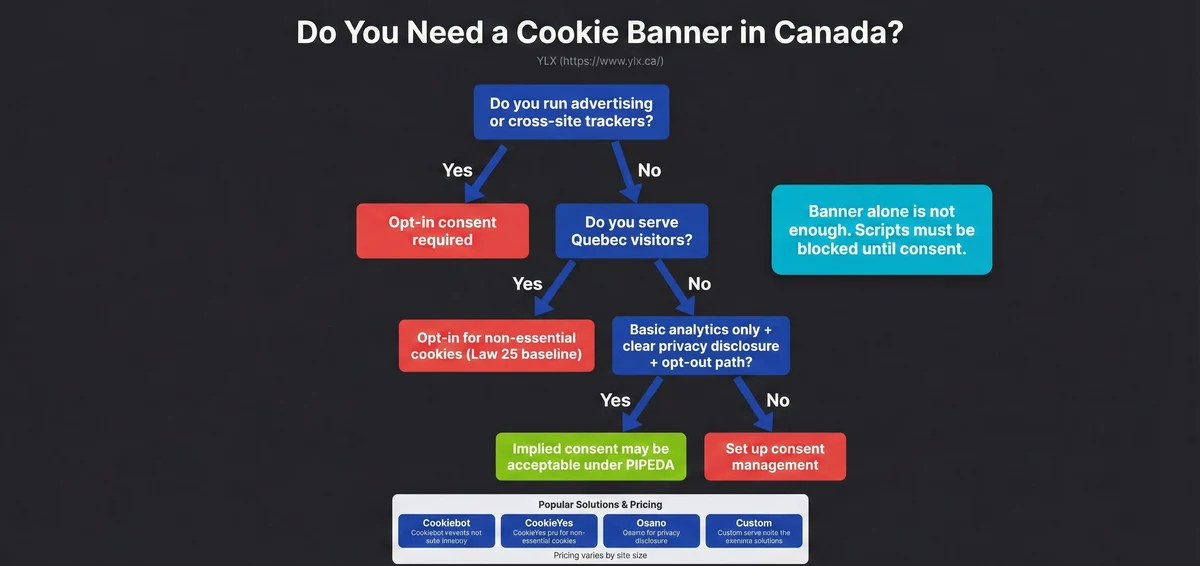
Cookie Consent for Canadian Websites: What You Actually Need
Not every Canadian website needs a cookie banner. Here's when consent is required under PIPEDA and Quebec's Law 25, and how to set one up properly.
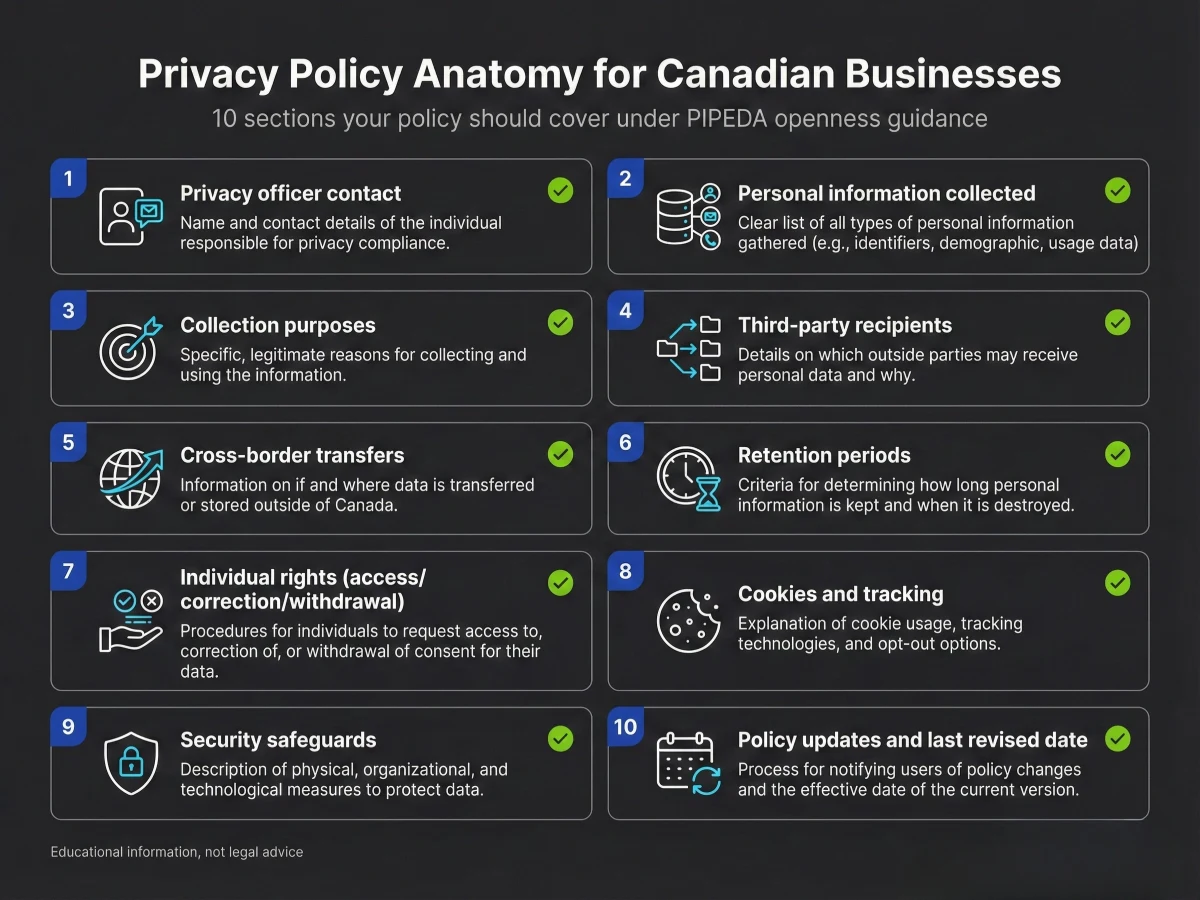
How to Write a Privacy Policy for Your Business Website
Your website needs a privacy policy that reflects what you actually collect. Learn what PIPEDA requires and how to write each section in plain language.
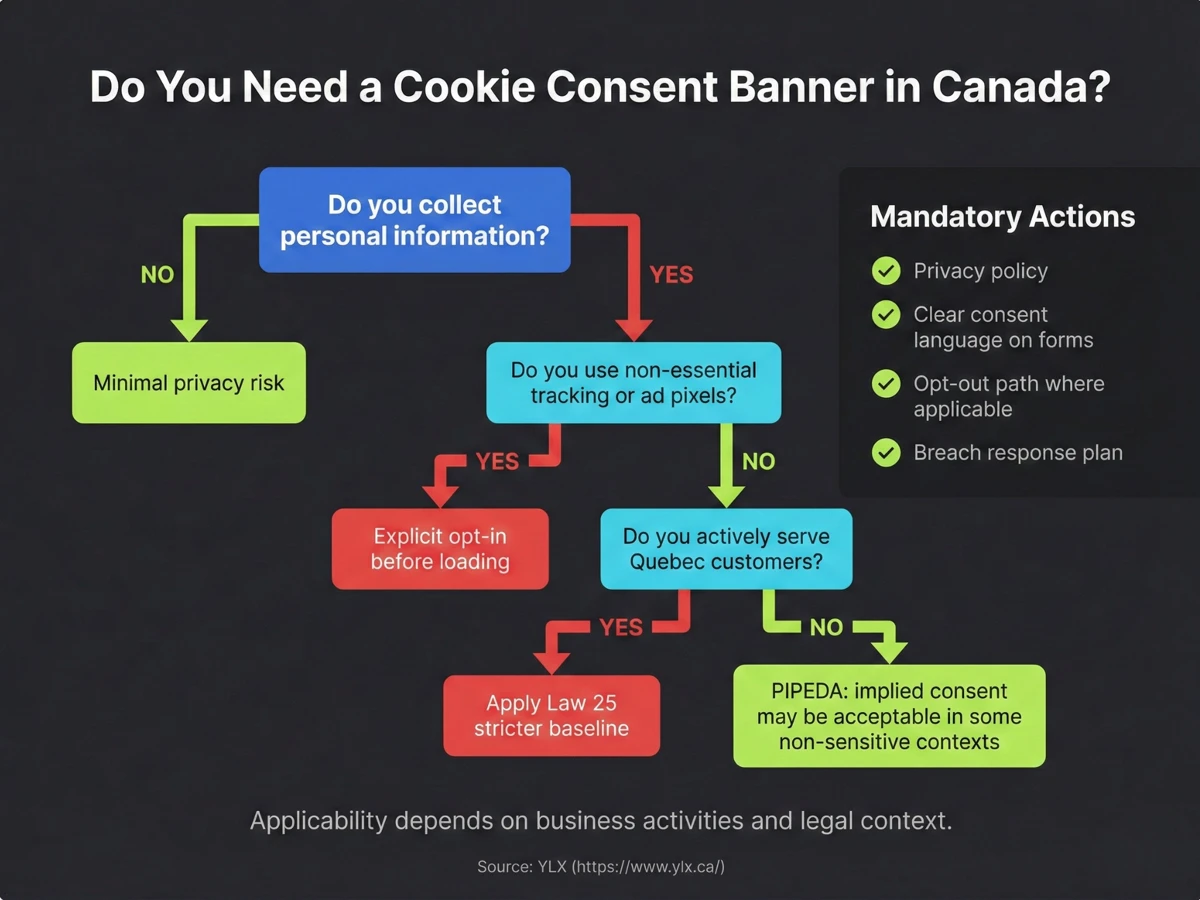
Website Privacy Law in Canada: A Guide for Business Owners
PIPEDA governs how Canadian websites handle personal data. Learn what your site needs for compliance, when cookie consent applies, and how Quebec Law 25 works.