Bill C-27 Failed: What Canadian Businesses Do Next
If you searched Bill C-27 Canada privacy because you thought a new federal law was already in force, stop there. It is not.
Bill C-27 died when Parliament was prorogued in January 2025. That means your business still has to comply with the laws that are active today, not the laws that were proposed. For most Ontario businesses, that means the Personal Information Protection and Electronic Documents Act (PIPEDA). If you serve Quebec customers, Law 25 can raise your obligations fast.
Here is the short version: stick to current law, fix policy and script mismatch first, tighten consent gating second, and assign breach ownership third.
Bill C-27 status: what actually happened
Bill C-27, the Digital Charter Implementation Act, was introduced in June 2022 and moved through early stages in Parliament. It did not complete the process. When Parliament was prorogued on January 6, 2025, the bill died on the Order Paper, along with other unfinished bills in that session (Gowling WLG (opens in a new tab)).
The post-prorogation election cycle added more delay. Canada then held the federal election in April 2025, which pushed privacy reform timing further out (Gowling WLG (opens in a new tab)).
That sequence matters because a lot of privacy content still talks like Bill C-27 became law. It did not. Any checklist that tells you to "comply with the Consumer Privacy Protection Act (CPPA) now" as if it is already binding is outdated.
What law applies to your business today
Right now, your baseline is the law in force, not the law that might return later in a different form.
1) PIPEDA is still the federal baseline
For most private sector organizations in Ontario, the active federal law is still PIPEDA (Justice Laws (opens in a new tab)).
PIPEDA covers how organizations collect, use, and disclose personal information in commercial activity. If your website has contact forms, newsletter signups, analytics, booking tools, or CRM integrations, you are already operating inside this framework.
What this means for you: the day to day fundamentals still apply. Clear purposes, meaningful consent, safeguards, breach handling, and accountability are current duties, not future duties.
2) Quebec Law 25 raises the practical standard
Quebec's private sector privacy law is the Act respecting the protection of personal information in the private sector, often called Law 25. It adds specific obligations that many businesses now treat as their default operating standard (LegisQuebec (opens in a new tab)).
Examples include appointing and publishing a person responsible for privacy, governance policies, and privacy impact assessments. They also include an incident register under sections such as 3.1, 3.2, 3.3, and 3.8 of the Act (LegisQuebec (opens in a new tab)).
Penalty exposure is also higher than many teams expect. In the enforcement framework in force since 2023, commonly cited ceilings are up to C$10 million or 2% of worldwide turnover for administrative penalties. For certain penal fines, cited ceilings can reach C$25 million or 4% (Osler (opens in a new tab)).
If you actively serve Quebec customers, this should be on your radar even if your office is in Ontario.
3) Alberta is signalling more movement, not less
Alberta's government has an active PIPA modernization process and has been publicly consulting on updates (Government of Alberta (opens in a new tab)).
That does not mean your Ontario business suddenly falls under Alberta law for everything. It does mean you should build to the stricter standard now, so you are not rewriting policies and scripts every quarter.
Why this matters for medium business owners
The biggest risk right now is not "being late for a future law." It is having a website that no longer matches your own privacy statements.
I keep seeing the same pattern in audits. A policy page says one thing. The scripts do another. A forgotten pixel from an old ad campaign still fires. A form still collects fields no one uses. A third party tool sends data to vendors nobody on the team remembers approving.
That gap is where complaints start. It is also where trust breaks first, often before legal action is even on the table.
Privacy compliance checklist for Canadian business websites showing immediate priorities: data inventory, policy and script alignment, consent controls, breach ownership, and province-specific checks.
If you want a quick baseline before making changes, our core guide on website privacy law in Canada covers the fundamentals and legal context.
What to do now: a practical action plan
You do not need a full legal overhaul in week one. You need a clear sequence.
Step 1: map your real data flow
Create a live inventory of every place your site touches personal information.
- forms and form fields
- analytics tags
- ad pixels
- chat widgets
- booking tools
- embedded third party scripts
- customer relationship management (CRM) and email automations
For each item, write down four things: what it collects, why it exists, where data goes, and who owns it internally.
If your team cannot answer those four questions in plain language, that is your first fix.
Step 2: align your policy with your actual setup
Most privacy pages are too broad and too vague. They look safe, but they are hard for users to understand and hard for your team to maintain.
Rewrite your privacy policy around what your site really does today. If your stack changes, update the policy in the same release cycle. Do not let it drift for months.
Our post on how to write a privacy policy for your business website gives a structure you can use.
Step 3: fix consent flow at the script level
A consent banner does nothing if scripts fire before consent is set. This sounds obvious, but it is one of the most common mistakes we see.
If you run non-essential tracking, gate those scripts properly. If you serve Quebec users, that point gets even more important.
If you need a practical setup path, use our guide on cookie consent for Canadian websites.
Step 4: assign breach process ownership
A breach plan is not a PDF in a folder. It is people, decisions, and timelines.
Assign one owner. Define who triages incidents, who decides whether reporting thresholds are met, and who communicates with affected users. Then run a tabletop exercise once, even if it is small.
This sounds operational because it is. In a real incident, unclear ownership causes more damage than weak wording.
Step 5: treat marketing and analytics as privacy systems
Many teams still separate "marketing tools" from "privacy compliance." In practice, they are the same conversation.
If you use Google Analytics, make sure your implementation matches your stated consent model and policy language. If you also run email programs, make sure your consent and communication practices stay aligned with Canada's Anti-Spam Legislation (CASL), S.C. 2010, c. 23 (opens in a new tab).
For those two areas, start with these related posts.
The children’s privacy signal most businesses should not ignore
Recent Canadian legal analysis continues to flag children's privacy as a federal priority area for coming reform work, alongside emerging technology risks (Osler (opens in a new tab), Torkin Manes (opens in a new tab)).
That does not create a new law overnight, but it is still an important signal. Regulators are clearly focused on youth data, consent clarity, and design choices that can shape user behaviour.
If your business has any chance of collecting data from younger users, review this now. The same applies if your user experience (UX) patterns are heavy on nudges.
Where most C-27 articles still fall short
In our experience reviewing current coverage, most pieces online follow one of these two paths:
| Approach | What it does | Why it falls short | Better alternative |
|---|---|---|---|
| History-only update | Recaps what happened to Bill C-27 | Leaves owners with no execution plan | Add a practical fix sequence for this quarter |
| Future-law speculation | Focuses on what a new bill might do | Skips current gaps that already create risk | Separate current duties from future scenarios |
Neither approach helps a business owner making decisions this month.
The better approach is simpler: separate current law from proposed law, map legal rules to technical behaviour, and prioritize fixes by business impact and risk.
That is how you turn legal uncertainty into a manageable action list.
What we do with clients at YLX
When we review a site, we are not looking for perfect legal language on day one. We are looking for consistency between your pages, your forms, your scripts, and your internal process.
In one recent cleanup, the biggest issue was not a missing policy section. It was an old third party script still running site-wide with no current business purpose. Removing that script reduced exposure and improved page speed in the same sprint.
That is the practical lens we use: fewer unknowns, fewer unnecessary data flows, cleaner systems, and clearer communication.
This article is educational information, not legal advice. Your exact obligations depend on your business model, data practices, and jurisdictions. For legal interpretation, speak with a qualified privacy lawyer.
Need Help With Privacy Compliance?
If you're not sure whether your website privacy setup reflects current Canadian rules, we can check it with you. We'll review your forms, scripts, and policy alignment, then explain what we find in plain terms.
Get a free privacy compliance review: Contact us at info@ylx.ca
Analysis FAQ.
Did Bill C-27 become law in Canada?
No. Bill C-27 died when Parliament was prorogued in January 2025. It never received third reading or Royal Assent, so it is not in force. Businesses still need to follow current laws like PIPEDA and applicable provincial rules.
What privacy law applies to most Ontario business websites right now?
For most private sector businesses in Ontario, PIPEDA remains the federal baseline for commercial activities. If you serve Quebec customers or operate across provinces, provincial privacy rules can add stricter obligations on top of that baseline.
Does Quebec Law 25 matter if my business is based in Ontario?
It can. If your Ontario business serves Quebec customers and collects their personal information, Law 25 can apply to those activities. In practice, many teams use one higher standard across all users to reduce legal and operational risk.
What should I fix first on my website this month?
Start with a data inventory. List every form, analytics tag, ad pixel, and third party script. Then map what each tool collects, why it exists, where data is sent, and whether your policy and consent flow still match reality.
Tagged with

Further Reading
Related Analysis.
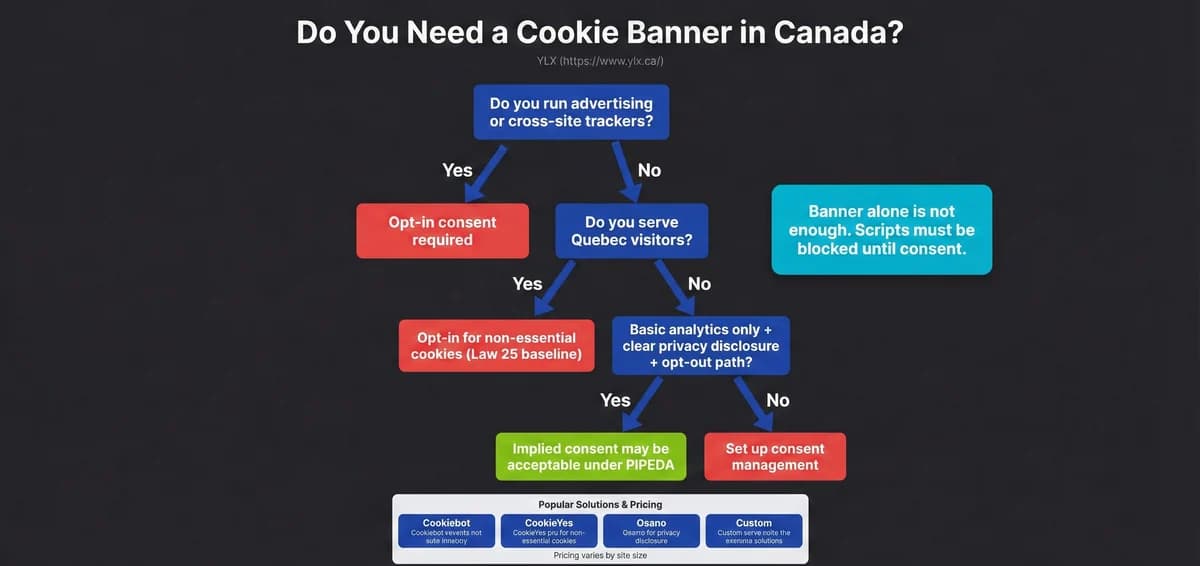
Cookie Consent for Canadian Websites: What You Actually Need
Not every Canadian website needs a cookie banner. Here's when consent is required under PIPEDA and Quebec's Law 25, and how to set one up properly.
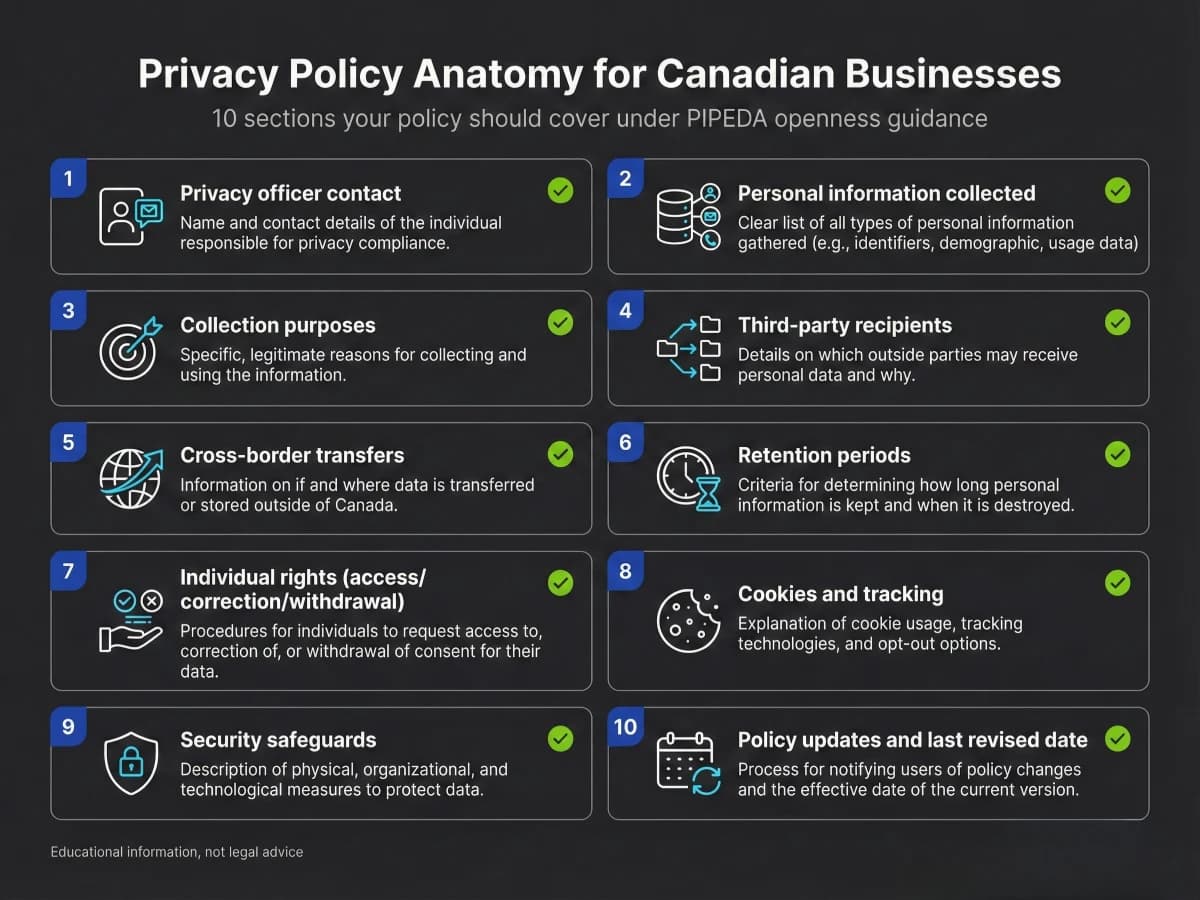
How to Write a Privacy Policy for Your Business Website
Your website needs a privacy policy that reflects what you actually collect. Learn what PIPEDA requires and how to write each section in plain language.
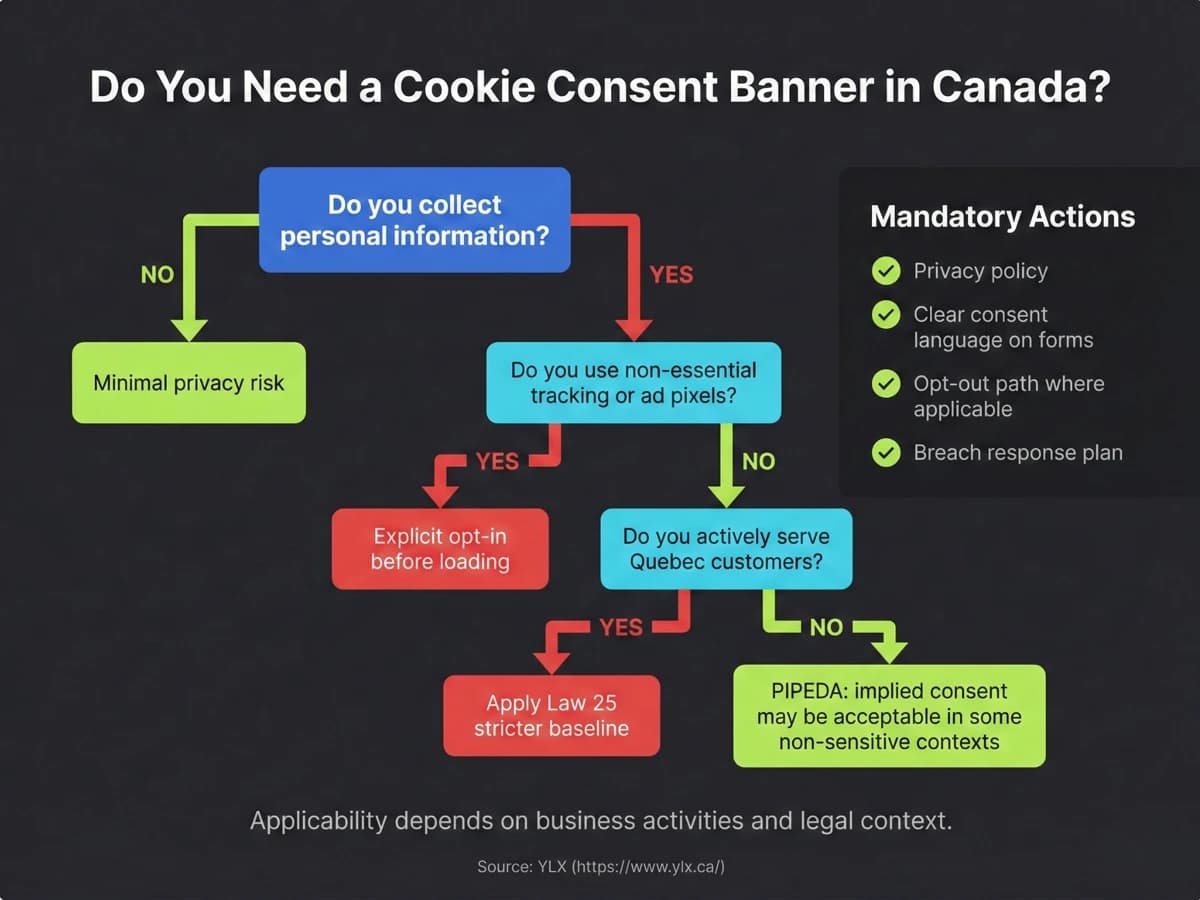
Website Privacy Law in Canada: A Guide for Business Owners
PIPEDA governs how Canadian websites handle personal data. Learn what your site needs for compliance, when cookie consent applies, and how Quebec Law 25 works.